Vector Privacy: Q3 2026 Report
Four releases, MVP reached, Concord v2, and a Human Rights Foundation Grant
The State of Privacy
In July, the European Parliament fell short of the votes needed to kill Chat Control. The proposal survived, and the argument moved behind closed doors into trilogue negotiations, where the fate of private messaging for roughly 450 million people would be settled without most of them watching.
On September 29, in the sixth of those negotiations, the compromise failed. Negotiators were asked to accept a reframing that would have relabelled mass scanning as "targeted" by pointing it at parts of a service rather than at named suspects. They declined. The Council's own legal service had already concluded that such a reading would amount to general and indiscriminate surveillance, and would not survive review. For now, end-to-end encrypted messaging remains outside the scanning mandate.
We want to be precise about what that is. It is a reprieve, not a resolution. The file returns to the table in November, and the pressure behind it has not weakened, it has only been redirected. Every quarter we have written one of these reports, the same proposal has still been alive at the end of it.
Meanwhile the machinery underneath carries on regardless of any vote. Identity checks spread to more of the services people depend on. Metadata, the record of who spoke to whom and when, is still collected by platforms that cannot read the messages themselves and sold by those that can. For a journalist protecting a source or an organizer working under a hostile government, the gap between a scanned conversation and a private one is not a policy preference. It is the difference between safety and exposure.
This is the ground Vector was built on, and Q3 was the quarter it got reinforced from two directions at once. We shipped four releases in nine weeks, including a second generation of the Concord Protocol and a bot platform built on it. And in August, the Human Rights Foundation backed Vector through its Bitcoin Development Fund, placing the project alongside fifteen others building tools for people who live where these questions are already settled badly.
We did not wait for the world to get safer. We built the tools that help people stay safe inside the one we have.
Features Added in Q3 2026
Where Q2 was a single deliberate leap, Q3 was a sprint. Four releases landed between July 14 and August 31, less about adding one large thing than about making the v0.4.0 foundation hold weight. Each feature links to its documentation.
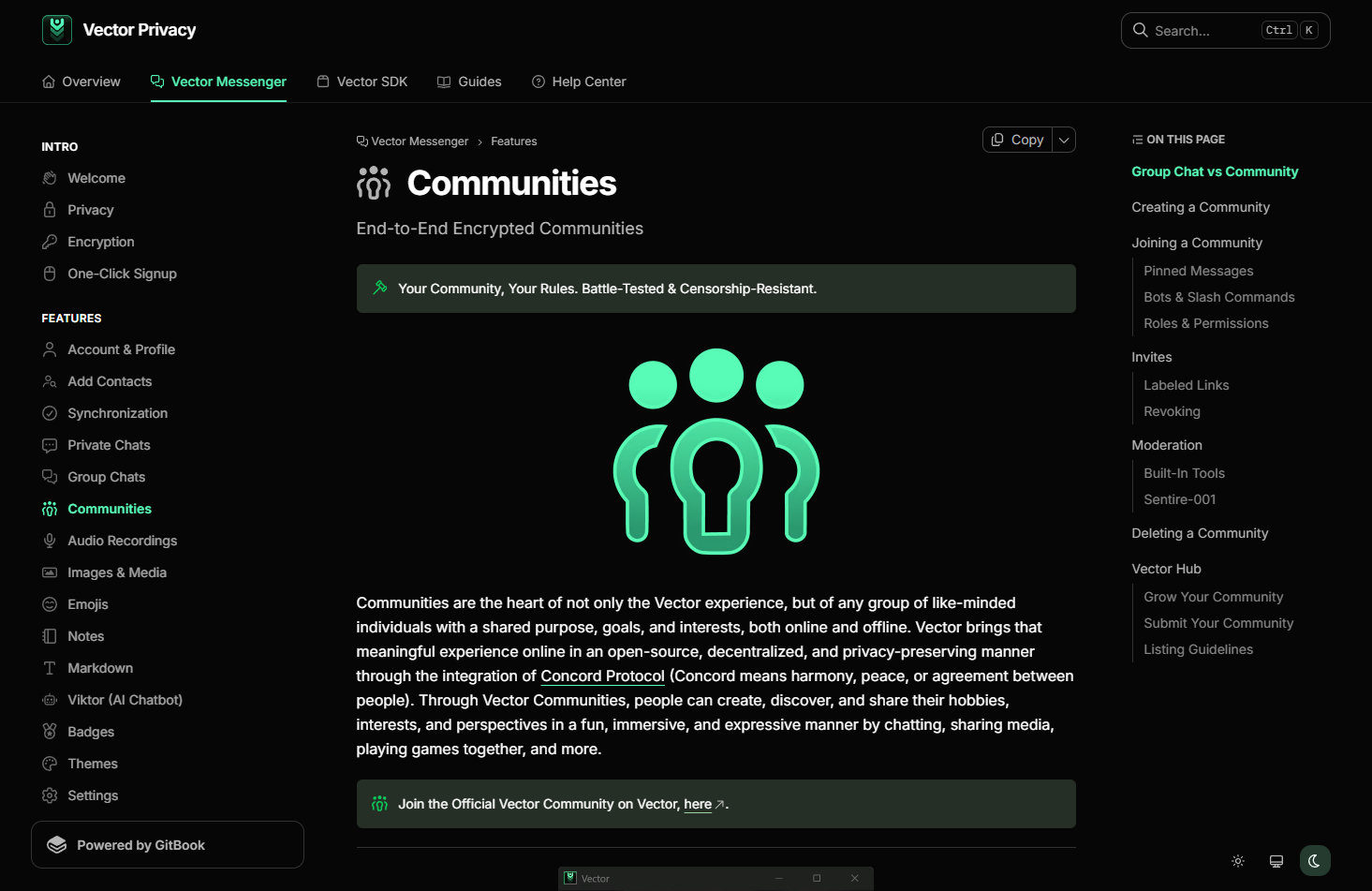
Communities & Moderation
- Concord v2 - Community addresses derive from the owner's key, and every admin action carries proof of authority
- Moderation at Speed - a whole wave of bans now costs one key rotation
- Raid Recovery - sever a raid in progress and close the way it came in
- Pinned Messages - pin rules and announcements for the whole channel
Bots & The Vector SDK
- Bots & Slash Commands - type / for a command picker, over encrypted messages
- Vector SDK - a few lines of Rust gets you a working bot
Privacy & Security
- Ephemeral Messages - per-chat timers that truly erase on both ends
- Amber Signing - on Android, your key lives in a separate vault
- Biometric Unlock - lock Vector behind your phone's screen lock
- EXIF Stripping - photos ship without location or device metadata
- Link Spoof Guard - links that hide their real destination are blocked
- Private Notifications - hide the sender, the message, or both
- Tor Refresh - four releases ahead of September's network transition
- Mini App Isolation - every Mini App gets its own storage
Identity & Expression
- Profile QR Codes - share and scan profiles instead of pasting keys
- Rich Message Composer - markdown, mentions and emojis render as you type
- Holographic Badges - tiered Bug Hunter badges on a 3D tilt, with real perks
- Status, Redesigned - a compact editor with a live preview
- Custom Emoji Fidelity - shortcodes survive copy, cut and truncation
Sync & Devices
- Synced Blocks, Mutes & Nicknames - your lists follow you between devices
- Pinned Chats - favourites stay at the top, on every device
- Account Switching, Rebuilt - background tasks stay bound to their own account
- Smart-Forwarding - resend a file you already hold without re-uploading it
- Per-Chat Drafts - unsent text stays where you typed it
Speed & Platform
- The Speed Pass - first sync fell from about a minute to about two seconds
- Volley Sync - Community channels paint newest-first at boot
- Media Mirroring - every upload is copied to a second server
- Self-Updating Sideloads - Android builds update themselves outside app stores
- Beta Updates Channel - opt into release candidates from Settings
- Linux & Wayland Polish - a proper desktop entry and working titlebars
For the full story behind each of these, with screenshots and the reasoning that shaped them, read the v0.4.1 and v0.4.2 release posts.
Release Summaries
v0.4.1 (July 14, 2026)
Seven weeks after Concord arrived, 518 commits landed in a release that calling a point update undersells badly. A second generation of the protocol, bots with real slash commands, ephemeral messages, keys that never touch the app, and a speed pass deep enough that first sync fell from about a minute to about two seconds. It is the release where the foundation laid in v0.4.0 started carrying real weight.
v0.4.2 (August 15, 2026)
325 commits across six preview builds, every one of them in Community hands within hours of being cut. Where v0.4.1 rebuilt foundations, v0.4.2 was about everything you touch while standing on them: the Rich Composer, profile QR codes, pinned chats and messages, a redesigned Status, and preferences that finally follow you between devices. It was also the first release shaped end to end by the new preview channel.
v0.4.3 (August 15, 2026)
A same-day follow-up, out roughly four hours after v0.4.2. Tor on Windows was freezing at 15% bootstrap and failing to connect on both x64 and ARM64, which is the kind of bug that matters most to exactly the people least able to report it. Also fixed: phantom typing indicators when another Nostr client was signed in under the same account, and dissolved Communities that would not stay dissolved across devices. We would rather ship a patch the same evening than leave a Tor user stranded for a fortnight.
v0.4.4 (August 31, 2026)
The quarter closed on hardening rather than headlines. Smart-Forwarding stopped Vector re-encrypting and re-uploading files it already held, raid recovery gave Community owners a way to sever an attack in progress, and a long list of fixes landed across key rotation, ban enforcement, member list sync, and Mini App networking. Linux got a proper desktop entry and working Wayland titlebars, Windows lost its DLL error popups, and Android notification replies started reaching the right conversation.
Human Rights Foundation Grant
On August 25, the Human Rights Foundation announced grants totaling more than 500 million satoshis through its Bitcoin Development Fund, across sixteen projects. Vector was one of them, listed under the heading Privacy by Principle.
What we value in their write-up is where it starts. Not with encryption, but with what Vector refuses to ask for: no account creation, no metadata trail, no permission to speak. That has been the design constraint since the first commit, and it is a particular kind of validation to have it read back as the point rather than as a feature.
The grant funds three things: Vector's first release on iOS alongside a widescreen desktop client, encrypted voice and video calls, and a stable censorship-resistant tool for journalists, activists, and whistleblowers. The first of those is already underway and is covered below.
It changes the pace, and it changes nothing else. Vector remains free and open source. There is no investor at the table, no equity sold, and no obligation attached beyond building what we already said we were building. A grant does not make software trustworthy. Being verifiable does.
We would also rather share the category than own it. Three other Nostr projects were funded in the same round, and a single encrypted messenger is a product where several interoperating on an open protocol is infrastructure. The full announcement is on HRF's site, and our own write-up is here.
Next Major Milestone: v0.5.0
v0.5.0 is already in progress on a dedicated branch, and it is the first grant deliverable to take shape. Here is where it stands.
Widescreen Desktop Client
The headline of v0.5.0, and work has started. A phone-shaped window does not do a Community justice on a large screen, so we are building a true four-pane desktop shell: the Community rail, your chats, the conversation and the community's details, side by side. It already runs that way on the branch, and narrower than 900px it folds back into the familiar phone layout. This is the release where Vector stops being a phone app that happens to run on a desktop and becomes a communication hub that earns the screen it is on.
Frontend Refactor
After roughly eighteen months of continuous development, it was time for a deep clean, and it is done. Vector's frontend now runs on Svelte, which compiles away at build time, so the app ships lighter and the interface updates itself when state changes rather than through hand-written wiring. Less code, and fewer places for bugs to hide.
Encrypted Voice and Video Calls
The second grant deliverable, and already working on the branch. Vector's call system is built in-house: one-to-one voice and video calls, with screen sharing, set up through the same encrypted messages as your DMs, with the two devices connecting directly, encrypted end to end. Calls work between desktops, in Vector Web, and on iPhone. Calls in Community channels come next.
Vector Web
Vector in the browser: the same app, with its Rust core compiled to WebAssembly, for anyone who can't or won't install it. It went live at the end of September, and your keys stay in your browser, never on our servers.
iOS
The third grant deliverable, and the platform gap we hear about most. A native app is next in line, and until it lands, Vector Web gives iPhone and iPad users Vector today. Added to the Home Screen, it runs like a native app, with voice and video calls and private, encrypted, low-metadata push notifications that arrive in the background, even with the app closed and the phone locked.
Community Polish
A steady run of improvements on top of the new foundation: richer roles, better moderation tools, and smarter discovery. The work that turns a strong first version into the place people spend the day.
Closing
The world did not become a safer place for privacy in Q3 2026. Chat Control survived the vote meant to stop it, and the only reason encrypted messaging is still outside its reach is that one negotiation in September refused a bad compromise. That file is back on the table in November.
Vector shipped four releases, built and improved the underlying protocol.
Privacy is a basic human right. We say it, we repeat it, and we build from it. Every feature in this report, every fix in every patch, and every install is one more step toward making that right real for someone who needs it. To everyone who ran a preview build, filed a bug with a log attached, argued with us about a design decision, or simply believed that a conversation should belong to the people having it: thank you.
The work continues.
Join the Vector Community
Get connected with the Vector Community, where you can meet other like-minded privacy advocates and make friends from around the world. Get the latest updates in development, insights, and some teasers only dropped in the Vector Community!
Join Community